




A product-page review of REHAB Your Hair’s milk-based wash pair and portioned hair oil, with a clear read on who may find the routine useful.
When a haircare range offers a cleanser, conditioner and several oils, the useful question is not whether every step sounds appealing. It is whether the products have distinct jobs, and whether those jobs match the gaps in a reader’s existing routine.
We reviewed the current product information for REHAB Your Hair. Its clearest proposition is a wash pair built around milky textures, alongside oils aimed at different routines. The pages explain ingredients and intended use, but they cannot tell every shopper how a formula will feel or perform on their own hair.
Heads-up: we earn a commission from some links in this article. It never changes the price you pay.
The short version: REHAB Your Hair has a legible routine logic: Shampoo Milk handles cleansing, Conditioner Milk adds rinse-out conditioning, and the Dose oils offer a more targeted finishing or treatment step. We think it is most relevant to readers who want to fill one specific haircare gap; those looking for independently demonstrated results or detailed formula percentages will find the product pages less conclusive.
The range works best when each product has a separate job
- For cleansing: begin with the product page for REHAB. Shampoo Milk and check its directions against your existing wash schedule.
- For rinse-out conditioning: REHAB. Conditioner Milk has the clearest ingredient-led explanation in the core pair.
- For a measured oil step: REHAB. Dose 1.0 Hair Oil makes portioning part of the format; fine-hair shoppers can compare the separate Dose 1.1 listing.
The most persuasive part of the offer is its practical segmentation. Instead of asking shoppers to buy a large routine without explanation, the brand gives a basic wash pairing and then separates oils by use case. That makes browsing easier, especially for someone who already knows whether their need is cleansing, conditioning, or an oil step.
For readers comparing the wash steps, the product pages for Shampoo Milk and Conditioner Milk make the intended sequence easy to follow. You can revisit the cleanser listing for its directions, then compare the conditioner page for its ingredient cues. Neither requires buying the pair together, and each can be judged against the products already in your bathroom.
The product descriptions also provide a few concrete anchors. Shampoo Milk is described as a milky cleanser intended to remove buildup without stripping moisture. Conditioner Milk calls out argan oil, hydrolysed plant proteins and shea butter. Dose 1.0 Hair Oil is presented in biodegradable capsules, while Dose 1.1 is the version positioned for fine hair. Those details give the range more definition than a string of broad shine claims.
This structure is useful because it gives shoppers a reason to select individual products rather than treating the complete range as an automatic routine. The trade-off is that “distinct job” is not the same as proof of a distinct result. The pages describe intended roles; readers still have to judge whether the textures and ingredients fit their own hair and preferences.

Shampoo Milk makes a moisture-conscious cleansing claim
Shampoo Milk is a sensible entry point for a shopper who wants a cleanser framed around comfort as well as removal of buildup. The brand says its milky formula cleanses without stripping moisture, an appealing objective for people who find conventional shampoo descriptions focused only on cleansing strength. The positioning is clear enough to compare with the cleanser already in your bathroom.
What remains open is just as relevant. The listing does not replace an ingredient-by-ingredient assessment for sensitivities, and the phrase “without stripping” is a brand claim rather than a result established by this review. It also does not establish the right wash frequency for every scalp. A reader with a specific scalp concern may need more tailored guidance than a general product page provides.
Our read is that Shampoo Milk is a plausible option for someone seeking a gentler-feeling wash proposition, especially if they value a clear product role over a long list of promises. It is less compelling as a blind switch for shoppers who need detailed evidence about performance, fragrance or suitability for a diagnosed condition.

Conditioner Milk has a more ingredient-led case
Conditioner Milk gives the wash pair a complementary second step. Its page highlights argan oil, hydrolysed plant proteins and shea butter, ingredients that help explain why the product is positioned around conditioning and manageability. The brand makes the formulation legible without requiring readers to infer the whole purpose from a product name.
A closer look at REHAB. Conditioner Milk is worthwhile for anyone comparing rinse-out options, while the matching REHAB. Shampoo Milk listing shows how the brand frames the preceding wash step. The two pages are useful for checking directions and ingredients side by side.
That description may suit shoppers who like a rinse-out conditioner with familiar emollient and protein cues. Yet ingredient presence alone does not predict how a conditioner will behave across different hair types, amounts used or styling routines. The available material also does not establish whether the product is lightweight enough for every person who avoids richer formulas.
- Review the full formula if you track particular ingredients.
- Use the stated directions to judge whether its rinse-out role fits your routine.
For that reason, the best case for Conditioner Milk is straightforward: it is a dedicated conditioning step with named ingredients, and its role pairs naturally with the cleanser. We would treat it as a candidate for comparison, not as a universal answer to dryness or tangling. Readers who already have a conditioner that works may have little reason to add another one.
- Check whether your routine has a real cleansing or conditioning gap.
- Read the product directions and full ingredient list on the current listing.
- Compare the texture and ingredient profile with products you already tolerate.
- Add one new step at a time so you can assess its place in the routine.
Dose oils make portioning and hair type part of the choice
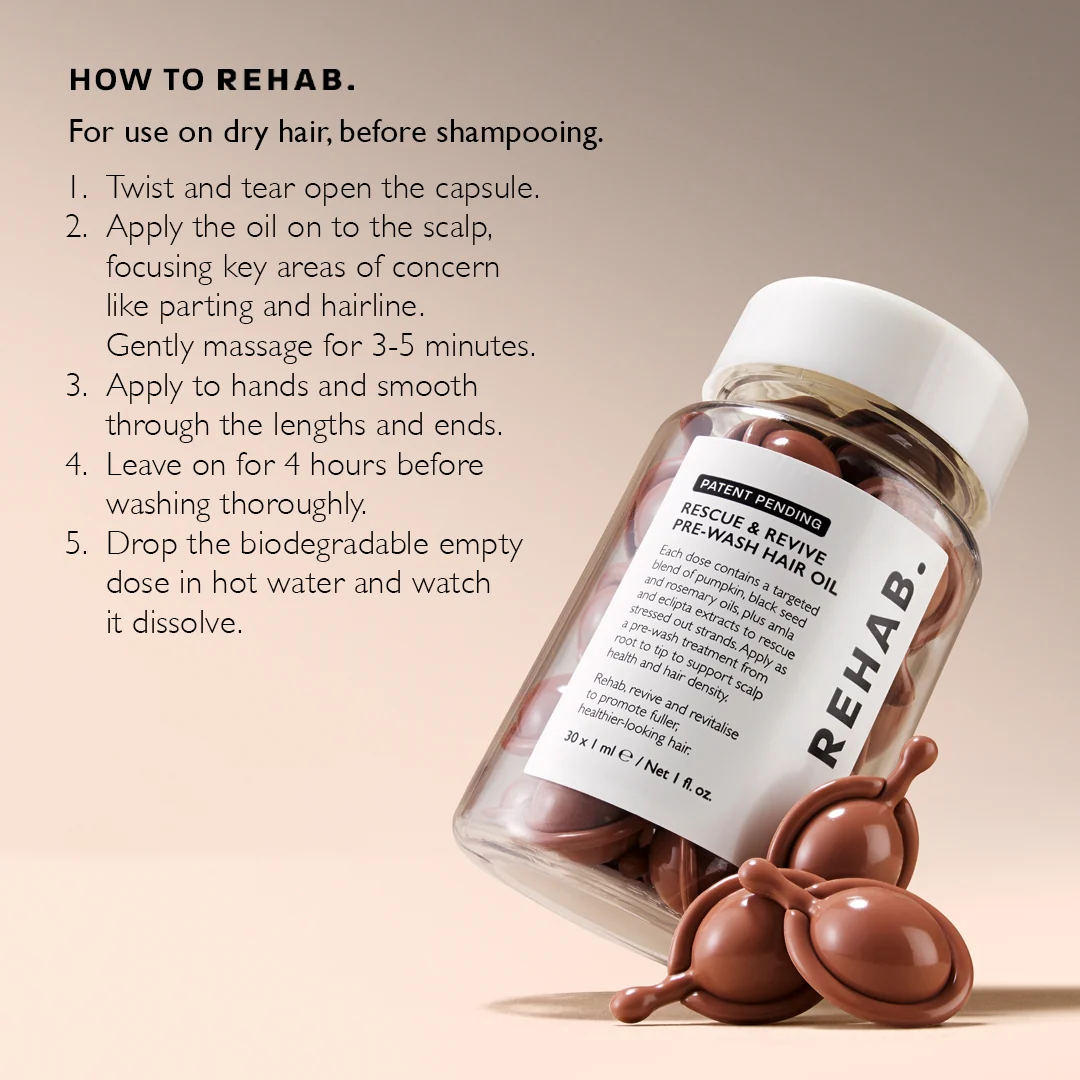
The Dose range is where the brand’s product logic becomes more specific. Dose 1.0 is delivered in biodegradable capsules, so the format offers a defined portion rather than an open bottle. That can appeal to people who prefer a prepared dose or want the oil step to feel distinct from daily leave-in products. The product page is the place to confirm directions and current pack details before choosing.
REHAB Your Hair also lists Dose 1.1 Fine Hair Oil as a separate option. This is a useful distinction in principle: people with fine hair often approach oils cautiously because of concerns about weight or residue. Still, a label aimed at fine hair does not guarantee a preferred finish. Hair density, length, styling choices and the amount applied all affect that experience, and the site does not provide independent comparative results.
Shoppers comparing the oils can look at Dose 1.0 Hair Oil alongside the listing for Dose 1.1 Fine Hair Oil, then decide whether capsules suit their habits. The Dose 1.0 page is also where to confirm the current pack details, while the Conditioner Milk listing provides a useful contrast if the real need is rinse-out conditioning rather than oil. The decision should turn on format and intended use rather than assuming one version is categorically better. The capsule concept is a real differentiator; it is also an added packaging format, which may be less appealing to someone who prefers a conventional bottle.
- Dose 1.0: the general oil option described with biodegradable capsules.
- Dose 1.1: a separate formulation positioned for fine hair.
- Pre-wash oil: a different route for readers who want an oil before shampooing rather than as a finishing step.
These distinctions help narrow the choice, but they also show why a single “best” oil would be misleading. The right listing depends on when you want to use oil, the amount of structure you want from the packaging, and how your hair responds to richer products. If none of those are unresolved needs, the oil range may simply add complexity.
The product pages leave performance questions with the shopper
- Look for the ingredient or format detail that matters to your own routine.
- Confirm directions and suitability notes on the individual product page.
- Compare the current price of one product with the cost of adding more steps.
If you are still deciding between wash and oil products, compare Shampoo Milk with Conditioner Milk, then open Dose 1.0 Hair Oil only if an oil step answers a separate need. Looking at the individual pages can clarify format and directions without implying that the products need to be purchased as a set.
Across the range, the store communicates ingredients, format and intended role more clearly than it communicates evidence. That is common on brand storefronts, but it matters in a review: product descriptions are useful for understanding what is being sold, not for confirming a personal outcome. We found enough detail to map the products into a routine, but not enough to make strong claims about lasting changes in shine, breakage, scalp comfort or manageability.
Before ordering, we would check the current product page for the full ingredient list, application directions, sizes and any practical details that can change. The cost of a routine can depend on how many steps you choose and how quickly each format is used up, especially when comparing a capsule oil with a conventional wash product. The store listing is the right place to see the current price and availability.
The individual pages for Shampoo Milk, Conditioner Milk and Dose 1.0 Hair Oil make that one-step approach practical: each has a different role to assess. If you are comparing options for a particular texture preference, read the relevant listing rather than extrapolating from another product in the range.
There is also a useful restraint in buying only what solves a known problem. A shopper who wants a cleanser can assess Shampoo Milk alone; someone already content with their wash routine might focus on whether an oil format adds value. This measured approach better matches what the available product information can support than treating a multi-step set as a necessary upgrade.

The honest verdict
REHAB Your Hair earns a positive assessment for clear product roles and useful distinctions between its wash pair and oil formats. We would recommend exploring the range to readers who can name a routine gap and want product pages that explain ingredients, use and format. Shampoo Milk and Conditioner Milk form the most coherent starting point; the Dose oils make sense for shoppers specifically drawn to a portioned oil or a fine-hair option.
The limitation is evidence: the storefront gives a credible account of what each product is designed to do, but does not settle how it will perform for an individual. Start with one relevant product, read its current details carefully, and treat the broader routine as optional rather than required.
Our recommendation: choose the REHAB Your Hair product that fills a specific routine gap, and keep the rest optional.